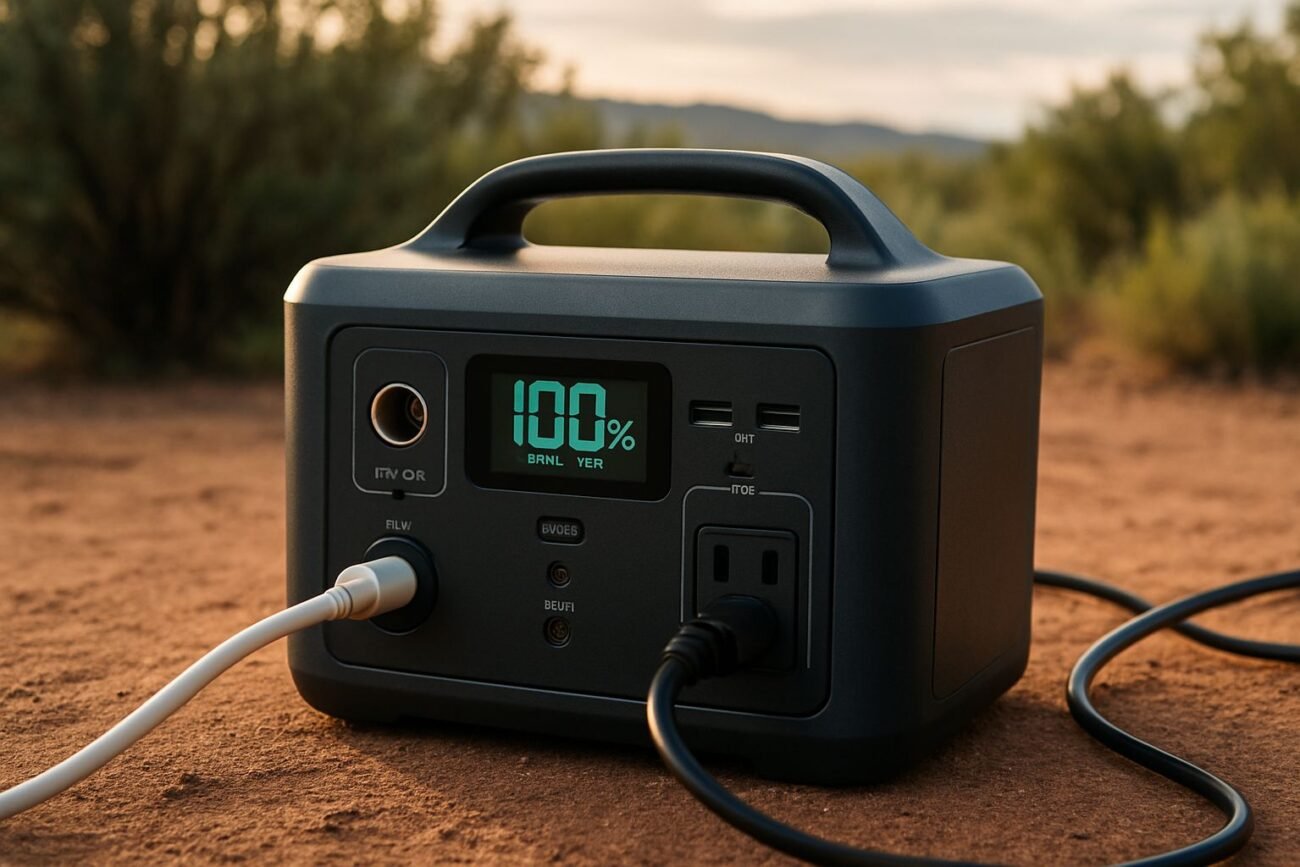
- The Jackery Explorer 500 packs 518Wh of capacity and a 500W output into a 13.32 lb unit — making it one of the most portable power stations in its class for real outdoor use.
- Customers consistently praise the Explorer 500 for its versatility, using it to power cameras, laptops, CPAP machines, mini fridges, and more on trips far from the nearest outlet.
- The Explorer 500 pairs seamlessly with Jackery’s SolarSaga solar panels, unlocking a fully off-grid charging setup that has changed how adventure travelers plan their trips.
- Loyal Jackery customers often start with smaller units and upgrade — the Explorer 500 sits in a sweet spot that keeps users coming back to the Jackery ecosystem for years.
- Curious how the Explorer 500 stacks up against the newer Explorer 500 v2? The differences might surprise you — keep reading to find out which one actually fits your adventure style.
The Jackery Explorer 500 Is a Real Adventure Companion
The Jackery Explorer 500 does not just sit on a shelf looking impressive — it goes where you go. Whether that means a mountain campsite three hours from the nearest town or the back of a converted van rolling through the desert, this power station has quietly become a trusted companion for thousands of outdoor enthusiasts. At 518Wh of capacity with a 500W rated AC output, it punches well above its weight for something you can carry with one hand.
Jackery is known for making portable power feel genuinely accessible, and the Explorer 500 is a prime example of that mission in action. It offers three output options — AC, USB-A, and a 12V DC car port — giving users the versatility to power anything from a DSLR camera battery charger to a portable fan without needing a pile of adapters. The LED display keeps things simple, showing battery percentage and real-time input and output wattage at a glance.
The Jackery Explorer 500 really stands out from its generic competitors due to the consistent real-world performance users report across platforms. It is not just the specs that sell people — it is the stories. Jackery, a leader in portable power innovation, has designed the Explorer 500 to hold up under the kind of conditions most people would not even attempt with a budget alternative. If you want to explore what Jackery offers across its full lineup, the range speaks for itself in both build quality and customer loyalty.
Who Are the Users of the Jackery Explorer 500?
The Explorer 500 is being used by a surprisingly diverse group of people. It’s not just for those who live off the grid or survivalists — it’s for photographers who are chasing the golden hour in remote locations, weekend campers who want their drinks cold and their phones charged, and remote workers who won’t let a dead battery interrupt their productivity. The common factor is the need for reliable, portable power that doesn’t require an engineering degree to use.
Field Photographers and Videographers
Creative professionals who work outside of the studio know that power is as essential as the equipment they use. The Explorer 500 can charge a typical mirrorless camera battery several times, power a laptop for editing previews on location, and keep a drone battery fully charged, all on a single charge. The pure sine wave AC output ensures that sensitive electronics such as camera chargers and monitors receive clean, stable power without the risk of damage from irregular current.
Off the Grid with Campers and Van Lifers
The Explorer 500 has become a hit with the van lifer community, and it’s easy to see why. The 13.32 lb unit can be stored in tight spaces with ease, and the multiple output ports mean that one unit can power an entire van. Users have reported being able to power LED lighting strips, a 12V cooler, charge their phone and tablet, and run a portable speaker all at the same time without any issues.
Van lifers in particular mention the Explorer 500’s passive cooling design, which means it runs silently without the constant noise of an internal fan. When your power source is just eight feet away from where you sleep, silence is not just a luxury, it’s a necessity. This quiet operation under moderate loads is something that budget units just can’t match.
Even those who prefer to camp in established sites are finding that the Explorer 500 eliminates the stress of powering devices that drain a lot of energy over the course of a long weekend trip. One of the most frequent uses customers mention in reviews is running a CPAP machine overnight. The Explorer 500 can power a standard CPAP device at around 30 to 60W for 8 to 15 hours on a single charge, depending on the settings used.
Mobile Office for Road Trippers
Nowadays, it’s hard to distinguish between vacation and work since remote work has become the norm. Road trippers are taking full advantage of this. The Explorer 500 allows you to set up a fully functioning workstation at a national park picnic table, a beach, or a trailhead parking lot. A standard laptop that uses around 45W can run for about 8 to 9 hours on the Explorer 500, which gives most professionals a full workday away from the grid.
Customer Opinions on the Explorer 500
Looking at verified customer reviews, several recurring themes become apparent — reliability, user-friendliness, and a level of satisfaction that exceeds the product’s listed specifications. Customers are not simply reviewing the product; they are recounting complete adventure stories about how the Explorer 500 revolutionized their adventure setup.
Dependable Energy Source for Extended Journeys Off the Beaten Path
Customers consistently mention that the Explorer 500 lives up to its promises, even after being used continuously over several days. A frequent story in the reviews is users anticipating the battery to falter on the second day of a camping trip, but discovering it still had a lot of charge left due to their smart energy use and the device’s own low self-discharge rate.
The Explorer 500’s built-in battery management system (BMS) protects against overcharging, over-discharging, short circuits, and extreme temperatures. Customers have noticed this in their use of the product. Units that have been in use for several seasons still report that they hold a charge well and provide consistent output. This is a testament to the long-term build quality for which Jackery is known.
Game-Changing Flexible Charging Options
Customers are genuinely thrilled about the Explorer 500’s ability to accept power input from three different sources: a standard wall outlet, a car’s 12V cigarette lighter port, or solar panels. This flexibility allows you to charge the battery while driving between campsites and then switch to solar once parked. You’ll almost never be left waiting for a wall outlet that may not be available. It’s this kind of redundancy that distinguishes a great power station from a good one.
Perfectly Sized for the Great Outdoors
Measuring 11.84 x 7.59 x 9.19 inches and weighing in at 13.32 lbs, the Explorer 500 is the perfect size for any adventure. It can fit under the seat of a truck, in a gear bag with camera equipment, or even in the corner of a tent vestibule. Many customers who have owned larger units often say that the Explorer 500 is the one they actually take with them on trips because the larger units are simply too bulky to bring along.
Many buyers underestimate the importance of size. A 1000Wh unit that sits in your garage because it’s too bulky to carry is worth nothing at the campsite. The Explorer 500 solves this problem by being a power station that you can always bring with you.
Ways Customers Use the Explorer 500 with Solar Panels
Many Explorer 500 owners have found that adding a Jackery SolarSaga solar panel to their system is a game-changer. With a solar input capacity of up to 100W, the Explorer 500 can theoretically be charged from zero to full in around 9.5 hours of direct sunlight with a single SolarSaga 100W panel. In practice, it usually takes between 8 and 12 hours, depending on the conditions. If you use two SolarSaga 100W panels, the charging time is significantly reduced.
Solar Panel Setup Input Wattage Estimated Charge Time (0% → 100%) Jackery SolarSaga 100W (x1) Up to 100W ~9.5 hours (ideal conditions) Jackery SolarSaga 80W (x1) Up to 80W ~12 hours (ideal conditions) Wall AC Outlet ~85W ~7.5 hours 12V Car Port ~45W ~14 hours
These numbers shift in the real world based on cloud cover, panel angle, and ambient temperature, but customers consistently report that a single SolarSaga 100W panel is enough to maintain a comfortable daily energy budget when usage is managed sensibly. Running the Explorer 500 at moderate draw during the day while the panel recharges it is a loop that many van lifers and overlanders have built their entire off-grid power strategy around.
Jackery hardware and Jackery solar panels are designed to work together. While some customers have reported inconsistent charging behavior when using third-party panels, those who use SolarSaga panels have reported a plug-and-play experience that works every time. The MPPT (Maximum Power Point Tracking) charge controller in the Explorer 500 optimizes solar input in real time, making the most of available sunlight.
It’s important to mention that the Explorer 500’s solar charging port uses an Anderson power connector, the same standard used for most of Jackery’s solar panels. This means you can upgrade your panels later without needing new cables or adapters. This is something that longtime Jackery customers specifically like about the company’s approach.
Going Completely Off-Grid with SolarSaga Panels
The Jackery SolarSaga 100W panel is the preferred choice to pair with the Explorer 500, and for good reason. The panel folds down to a compact 24 x 21 x 1.4 inch package, weighs just 10.33 lbs, and has a kickstand that lets you angle it toward the sun without needing a mounting system. Customers who take the Explorer 500 and a SolarSaga 100W panel on week-long backcountry trips report that they can maintain enough daily charge to run lights, charge devices, and even run a small fan — indefinitely, as long as the sun cooperates.
What Can You Really Power with 500Wh?
This is the question that every new buyer wants to know, and the truthful answer is: more than you think. The 518Wh capacity of the Explorer 500 translates to real-world runtime that covers most adventure scenarios comfortably. Here is a practical breakdown of what you can expect:
- Smartphone (10Wh battery): Up to 40 full charges
- Laptop (45W draw): Approximately 8 to 9 hours of continuous use
- CPAP machine (30 to 60W): 8 to 15 hours depending on pressure settings
- Mini fridge (40W average): Around 10 to 12 hours of runtime
- LED camping light (5W): Up to 80+ hours
- Camera battery charger (15W): Roughly 25 to 30 full camera battery charges
- Drone battery charger (50 to 80W): Approximately 5 to 8 full drone battery charges
From Power Banks to Power Stations: The Jackery Customer Journey
A pattern shows up repeatedly when you dig into long-term Jackery customer reviews — people rarely buy just one unit and stop there. The typical journey starts with a small power bank for day hikes, then steps up to an Explorer 240 or Explorer 300 for weekend camping, and eventually lands on the Explorer 500 as the primary adventure power source. At that stage, the Explorer 500 often becomes the unit customers keep for years, building the rest of their gear decisions around it.
What Makes Jackery’s Customers So Loyal?
It’s simple — Jackery’s products deliver on their promises. With so many portable power stations on the market that exaggerate their specs and then fail to live up to them, Jackery has managed to build a loyal customer base by consistently meeting its advertised specs. Customers who have had their Explorer 500 units for two, three, or even four years are still posting updates about how well the battery maintains its capacity after hundreds of charge cycles. This is directly related to the high-quality lithium-ion cells that Jackery uses in its manufacturing process.
Jackery Products: Evolving to Meet Customer Demands
Jackery’s launch of the Explorer 500 v2 is a prime example of the brand’s commitment to taking on board customer feedback and making valuable improvements. The v2 model keeps the same fundamental 512Wh capacity and 500W output as its predecessor but incorporates a LiFePO4 (lithium iron phosphate) battery — a major change that increases the cycle life from around 500 cycles with the original model to a projected 4,000 cycles with the v2. This enhancement could mean up to ten years of regular use for customers who frequently use their power station before the battery starts to noticeably deteriorate.
Aside from the battery chemistry, the Explorer 500 v2 also includes quicker AC charging and a revised port layout that mirrors how customers use the device in real-life situations. These are not just aesthetic upgrades — they are focused improvements that are based on genuine customer feedback. This type of product development is one of the primary reasons why Jackery customers don’t usually look elsewhere when it’s time to upgrade. The brand secures the next purchase by demonstrating that it values the current one.
The Explorer 500 is Part of a Larger Jackery Ecosystem
The Explorer 500 is not an independent entity — it is part of a meticulously crafted power ecosystem that Jackery has developed over years of product innovation. Every port, every cable standard, and every charging protocol is designed to integrate effortlessly with other Jackery products. This means that the SolarSaga panels you purchase today will still be compatible with the Explorer 1000 v2 you may upgrade to in three years. This level of forward compatibility is seldom found in the consumer electronics industry and is something that Jackery customers truly appreciate.
For those who own more than one unit, the Jackery app provides a unified interface to monitor battery status and real-time usage across all connected devices. This is especially useful when managing power across a van setup or a base camp with multiple charging needs. The Explorer 500 is the mid-range workhorse of this ecosystem, offering serious power in a portable package that can grow with your setup over time.
Does the Explorer 500 Still Hold Up in 2024?
Given the recent release of the Explorer 500 v2 and Explorer 600 v2, you may be wondering whether the original Explorer 500 is still a good buy. The answer largely depends on your specific needs. If you’re purchasing a new unit, the Explorer 500 v2, with its LiFePO4 battery chemistry and longer cycle life, is likely a better long-term investment. However, if you’re already an owner of the original Explorer 500, there’s little need to upgrade — its core performance remains competitive, and it continues to deliver on its initial promises.
Despite the surge in competition in the portable power station market, the Explorer 500 continues to stand out due to its unmatched reputation, backed by thousands of customers. While the specs on paper are impressive, what really sets it apart is its proven reliability. It’s been tested on mountain trails, desert roads, and remote campsites, enduring years of heavy use.
The Explorer 500 is more than just a portable power source. It’s a symbol of the moment portable power became truly practical for everyday adventurers. It offers the perfect balance of capacity, portability, port selection, and price. Even though newer models may exist, the legacy of the Explorer 500 lives on. Every new owner who takes it out into the field and returns with stories to tell reinforces this legacy.
Feature Jackery Explorer 500 Jackery Explorer 500 v2 Jackery Explorer 600 v2 Capacity 518Wh 512Wh 640Wh AC Output 500W (1000W surge) 500W (1000W surge) 600W (1200W surge) Battery Type Lithium-Ion (NMC) LiFePO4 LiFePO4 Cycle Life ~500 cycles to 80% ~4,000 cycles to 80% ~4,000 cycles to 80% Weight 13.32 lbs ~13.4 lbs ~14.3 lbs Solar Input Up to 100W Up to 100W Up to 200W AC Charging Speed ~85W Faster (updated) Faster (updated)
Frequently Asked Questions
The Explorer 500 generates a lot of questions from buyers who want to know exactly what they are getting before they commit. The specs tell part of the story, but the real-world answers matter more. Below are the most common questions — answered straight, with no fluff.
Regardless of whether you are a novice power station purchaser or you are upgrading from a smaller model, these responses will assist you in understanding precisely how the Explorer 500 integrates into your adventure setup and what you can anticipate from it in the field.
Is it Possible to Power a Laptop and Coffee Maker Simultaneously with the Jackery Explorer 500?
The answer to this question is entirely dependent on the wattage of your coffee maker. The Explorer 500 provides a continuous AC output of 500W with a surge capacity of 1000W. A standard drip coffee maker typically requires between 600W and 1200W — which means most full-size coffee makers will either trip the unit’s overload protection or sit right at the edge of its capacity. A low-wattage travel coffee maker that requires around 300W, however, will run comfortably alongside a laptop that requires 45W without any issues. If having coffee in the field is a priority, you should check the wattage on your specific device before assuming it will be compatible.
How Much Time Does the Jackery Explorer 500 Need to Charge Using Solar Panels?
When using a single Jackery SolarSaga 100W panel in perfect direct sunlight, the Explorer 500 can charge from empty to full in about 9.5 hours. However, in typical conditions where there might be some cloud cover or the panel angle isn’t perfect, it can take between 10 to 13 hours. The Explorer 500’s solar input tops out at 100W, so even if you add a second panel in parallel, it won’t charge any faster because the input limit is the bottleneck. If you want faster solar charging, the Explorer 500 v2 and Explorer 600 v2 both support higher solar input wattages.
Is the Jackery Explorer 500 a good choice for weekend camping trips?
Definitely. If you’re going camping for two to three days and you’ll be using devices moderately — think cell phones, a laptop, LED lights, and a small fan — the Explorer 500 has more than enough capacity to meet most people’s needs without needing to be recharged in the middle of the trip. It weighs 13.32 lbs, so you can bring it to the campsite without it being too heavy, and it has multiple output ports so everyone can charge their devices at the same time. If you’re a solo traveler or a couple going on weekend adventures, it’s one of the most practical power stations you can get for its size and price.
What are the differences between the Jackery Explorer 500 and the Explorer 500 v2?
Both the original Explorer 500 and the Explorer 500 v2 have the same basic output specs, including a 500W AC output and a capacity of about 512 to 518Wh. However, they differ greatly in terms of their internal components. The v2 uses LiFePO4 battery chemistry, which provides an estimated 4,000 charge cycles, compared to the original’s roughly 500 cycles. This means that the v2 can last about eight times longer before you start to notice a decrease in capacity. The v2 also charges more quickly from AC power and has a new port layout. If you’re buying a new one, the v2 is the smarter long-term choice. If you already have the original, it still works well and doesn’t need to be replaced immediately.
Can the Jackery Explorer 500 Be Used While Charging?
Yes — the Explorer 500 has pass-through charging, which means you can plug in devices and draw power from the unit while it is also being recharged from a wall outlet or solar panels. This is especially useful in situations where you have limited access to power and need to keep devices running without waiting for a full charge cycle first.
It’s important to note that when the Explorer 500 is used in pass-through mode for extended periods of time, it can generate a bit more heat than usual. This could potentially affect the battery’s health over time if used for many cycles. However, for occasional use, the pass-through charging feature works perfectly as it should. If you plan on using the Explorer 500 as a permanent backup power source at home, Jackery suggests that you cycle the battery every now and then instead of keeping it in pass-through mode all the time.
You didn’t provide any content for me to rewrite. Could you please provide the content that you want me to rewrite?
