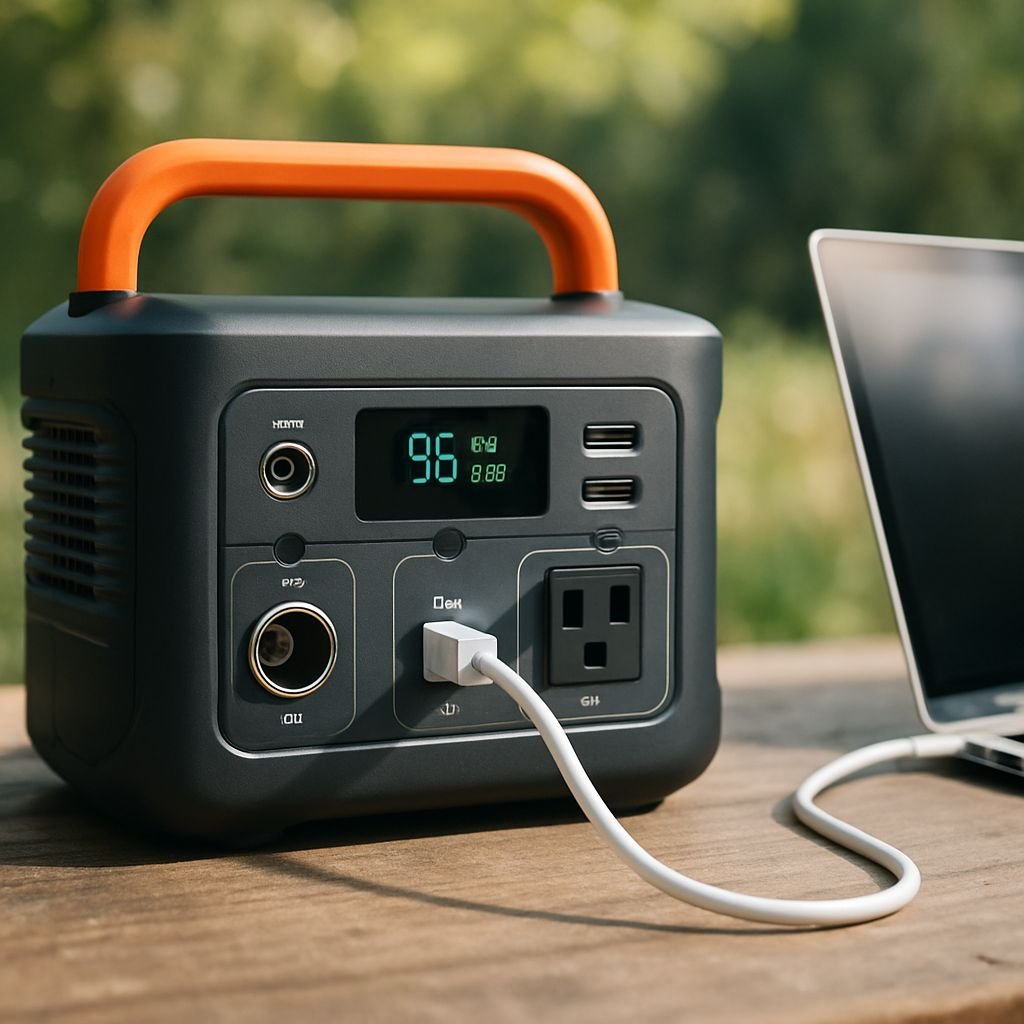
- The Jackery Explorer 2000 Plus packs 2,042Wh of LFP battery capacity and a 3,000W inverter — enough to run a full-size refrigerator, power tools, and most home appliances during an outage.
- Its biggest advantage over the 2000 V2 is expandability — you can stack up to five battery packs to reach a massive 12,252Wh of total capacity, making it a genuine whole-home backup option.
- The 2000 Plus charges from 0–80% in about 1.8 hours via wall outlet using its fast-charge mode, one of the quickest recharge times in its class.
- It’s heavier and pricier than the Jackery Explorer 2000 V2, but the extra ports, 30A outlet, higher solar input, and expansion capability make it the smarter long-term buy for serious off-grid users.
- Keep reading to find out exactly who should buy the 2000 Plus — and who is better off saving $500 with the V2 instead.
The Jackery Explorer 2000 Plus: What You Need to Know First
The Jackery Explorer 2000 Plus sits at the top of Jackery’s Explorer lineup for a reason — it’s built for people who need more than a weekend camping companion.
The Jackery Explorer 2000 Plus is a solar generator that offers a lot of power and flexibility. Unlike other portable power stations that have a set battery size, the 2000 Plus allows you to expand. It starts with a base unit that offers 2,042Wh of power. You can then add Jackery’s dedicated Battery Pack 2000 Plus modules. You can add up to five of these modules to increase the total capacity to 12,252Wh. This isn’t just for camping anymore. This is for serious emergency backup and off-grid living. Shop Solar Kits carries the full Jackery 2000 Plus ecosystem, including expansion packs, for those who want to create a complete energy independence setup.
Jackery has chosen to use lithium iron phosphate (LFP) technology in the Explorer 2000 Plus, which is a significant improvement over the older NMC cells. The LFP cells are better equipped to handle deep discharge cycles, they run at a cooler temperature, and they can endure many more charge cycles before their capacity starts to decrease. In fact, Jackery has rated the 2000 Plus for 4,000 cycles to 70% capacity. This means that you could use it every day for over a decade.
Quick Overview of the Jackery Explorer 2000 Plus
Before we dive into how the 2000 Plus performs in real life, let’s take a look at its specifications. This information is important when you’re trying to determine if this device can meet your unique power requirements.
|
Specification |
Jackery Explorer 2000 Plus |
|---|---|
|
Battery Capacity |
2,042Wh |
|
Battery Type |
LFP (Lithium Iron Phosphate) |
|
AC Output |
3,000W continuous / 6,000W surge |
|
AC Outlets |
4x standard + 1x 30A RV outlet |
|
USB-A Ports |
2x (18W each) |
|
USB-C Ports |
2x (100W each) |
|
DC Car Port |
1x (12V/10A) |
|
Solar Input |
Up to 1,000W |
|
Wall Charge Time (0–80%) |
~1.8 hours |
|
Full Wall Charge Time |
~2 hours |
|
Maximum Expandable Capacity |
12,252Wh (with 5x battery packs) |
|
Weight |
61.7 lbs (base unit) |
|
Life Cycle |
4,000 cycles to 70% capacity |
|
App Control |
Yes (Jackery App via Bluetooth/Wi-Fi) |
Battery Capacity and Cell Type
The Jackery Explorer 2000 Plus is built around a 2,042Wh LFP battery. LFP batteries are currently the best choice for stationary and semi-portable energy storage. They are more thermally stable than NMC (nickel manganese cobalt) batteries, which means they don’t overheat as easily. This is important when you’re running high loads for long periods. The battery is rated for 4,000 cycles, which means if you used it once a day, it would last over 10 years before its capacity dropped to 70% of its original capacity.
Just to give you a comparison, most of the competition in the 2,000Wh range are still using NMC cells that are rated for 500-800 cycles. This is a significant advantage for the LFP, especially for those who plan to use this unit on a regular basis rather than just keeping it on hand for emergencies.
AC Output and Surge Wattage
With a 3,000W continuous AC output, the Jackery Explorer 2000 Plus offers a significant improvement over the 2,200W inverter in the Jackery Explorer 2000 V2. This additional 800W of capacity makes it possible to run appliances that the V2 simply can’t — such as portable air conditioners, electric grills, power saws, and well pumps. Thanks to the 6,000W surge capacity, it can manage the startup spike from motor-driven appliances without tripping.
The 30A RV outlet is a feature that’s only available with the 2000 Plus. If you’re looking to power an RV or a large appliance that needs a 30A connection, then this is the unit for you. The V2 doesn’t come with this feature.
Solar Input and Charging Options
The 2000 Plus is capable of accepting up to 1,000W of solar input. This means that, in theory, it could recharge from empty in about two hours of peak sunlight. This would require six Jackery SolarSaga 200W panels running simultaneously. However, in real-world conditions where there may be partial shade or the panels may not be at the optimal angle, you should expect it to take four to six hours. This is still competitive for a unit of this size.
Options for charging include:
- AC wall outlet — fastest method, 0–100% in approximately 2 hours
- Solar panels — up to 1,000W input, ideal for off-grid sustained use
- 12V car charging — slower, best used as a supplemental top-up method
- Dual charging — simultaneous solar + wall charging is supported
Weight, Dimensions, and Build Quality
At 61.7 lbs, the 2000 Plus is not a unit you’re going to carry by hand across a campsite. Jackery includes a telescoping handle and integrated wheels to compensate — but as we’ll cover in the usability section, those wheels are one of the unit’s weaker design elements. The overall build is solid and durable, with a rubberized exterior that holds up well to outdoor conditions.
Its dimensions are 20.1 x 10.6 x 12.1 inches, so it’s compact enough to fit in the cargo area of most SUVs or the bed of a truck without taking up too much room.
Jackery 2000 Plus Performance in Real Life
Specifications are just one piece of the puzzle. The real test of the 2000 Plus is how it powers the devices people use most often — and in this area, it truly shines.
Operating a Fridge and Other Large Appliances
A typical full-sized fridge uses between 100-400W, depending on the model and compressor cycle. With the Jackery 2000 Plus, you can keep a mid-sized fridge running continuously for between 12 and 20+ hours on a single charge, depending on how frequently the compressor starts up. During testing, the 2000 Plus was able to manage the power demands of a fridge without any problems – there was no flickering, no power cuts, and a consistent output throughout.
When it comes to larger loads, the Jackery Explorer 2000 Plus performs just as well. A portable space heater that uses 1,500W ran without any problems. A window AC unit that draws around 1,200W was also able to run without causing any voltage irregularities. The 3,000W inverter provides a significant amount of headroom, which is evident in how effortlessly the unit manages multiple simultaneous loads.
Charging Speed From Wall and Solar
Charging the 2000 Plus from a wall outlet is a breeze. In our tests, it reached 80% in less than two hours, which is one of the fastest recharge rates for a portable power station of this size. A full charge from zero took just about 2 hours, so even if you only have a short window of time during a power outage, you can still get a decent amount of charge before the power goes out again.
The rate at which the battery charges using solar power is largely influenced by the weather conditions. If you’re using a 400W panel in the height of summer, you can expect the battery to be fully charged in around 5-6 hours. If you increase the input to 800W or even the maximum 1,000W, this time will be considerably reduced. The MPPT solar charge controller that Jackery uses is very effective at getting the most out of the panels, and the system is compatible with panels from other manufacturers as well as those in Jackery’s SolarSaga range.
Performance of Idle Draw and Efficiency
Many larger power stations fail to impress in one area: idle draw. This is the energy that the inverter uses just by being on, even when nothing is plugged into it. The 2000 Plus handles this fairly well, with an idle draw that typically falls in the 15–20W range. This is pretty good for a 3,000W inverter. It’s not the best in its class, but it won’t deplete your battery overnight from idle alone.
Expandable Battery: The Ace Up the 2000 Plus’s Sleeve
The Jackery Explorer 2000 Plus’s expandable battery system sets it apart from the rest of the 2,000Wh pack. Most portable power stations are fixed systems — you’re stuck with what you buy. The 2000 Plus completely shatters that paradigm.
The 2000 Plus is an excellent camping unit, but what makes it a viable home backup solution is its expandability. It’s a game-changer that’s hard to put a price on, whether you’re preparing for multi-day outages, building out an off-grid cabin setup, or simply want the peace of mind that comes with serious energy reserves. The ability to scale capacity on demand is what transforms the 2000 Plus from a capable camping unit into a legitimate home backup solution.
The Battery Pack Expansion Process
Jackery has created a dedicated expansion battery, the Battery Pack 2000 Plus, which connects directly to the base unit through a specific cable. Each pack provides an additional 2,042Wh of LFP capacity. The process of connecting is simple: plug the expansion cable into the port on the base unit designated for this purpose, and the system will automatically detect the extra capacity. There’s no need for a complicated setup or a separate inverter. The base unit’s built-in battery management system (BMS) handles everything.
Expandable Capacity at its Maximum
When the system is fully expanded — with five Battery Pack 2000 Plus modules linked to the base unit — the total system capacity hits 12,252Wh. In more understandable terms, that’s enough power to keep a full-size refrigerator running non-stop for four to five days, keep a portable AC unit powered for over 20 hours, or keep vital home circuits running during a power outage that lasts several days.
By simply including one expansion pack, you can increase your capacity to 4,084Wh, which significantly lengthens the runtime on high-power appliances. The modular method allows you to begin with the base unit and gradually increase capacity as your requirements — or budget — expand over time. This type of long-term adaptability is uncommon in this product category and is one of the most compelling reasons to choose the 2000 Plus over any fixed-capacity competitor.
Connections, Screen, and Functionality
While power output is important, the daily use of a device is often dictated by the finer points — how many devices can be connected at once, how well the screen displays information, and how simple it is to transport the unit. The 2000 Plus performs well in most of these areas, with one significant exception.
Jackery has a well-organized and generous port layout. The AC outlets, USB ports, and DC outputs are grouped on the front face of the unit with clear labeling. This makes it easy to quickly identify the right port, even in low-light conditions at a campsite or during a power outage.
Number of AC Outlets and USB Ports
The Explorer 2000 Plus offers four standard AC outlets and an exclusive 30A RV outlet — a feature that the Explorer 2000 V2 does not have. The two USB-C ports each provide 100W, which is fast enough to charge a laptop at full speed while also powering another device. The two USB-A ports each provide 18W, which is enough for phones, small lights, and accessories. In most situations, the number of ports is more than enough.
Where the 3,000W inverter rating really comes into play is when you’re running multiple high-draw devices at once. Imagine running a refrigerator, a laptop, two phone chargers, and a fan all at the same time without even coming close to maxing out the unit. That kind of overhead gives the 2000 Plus a sense of confidence and capability, rather than feeling like you’re always on the edge of maxing out the wattage.
Screen Clarity and App Compatibility
The LED screen on the front of the device shows the input and output wattage, as well as the estimated remaining runtime or charge time, in a format that is easy to understand. The screen is bright enough to be used outdoors during the day, although it does not have the highest contrast compared to others in its category. The estimated runtime calculation changes dynamically based on the current draw, which is extremely helpful when trying to manage power during a trip that lasts several days.
With the Jackery app, you can connect via Bluetooth or Wi-Fi and get a mirror image of everything on the display. You also get the added benefit of remote control functionality. This lets you switch the AC output on or off, check the battery status, and keep track of charge cycles from your phone. While it’s not a must-have, it’s a well-implemented feature that genuinely adds to the convenience. This is particularly true if you want to monitor overnight charging or check the status without having to walk over to the unit.
Wheel and Handle Design: A Major Flaw
At 61.7 lbs, the 2000 Plus absolutely needs its wheels and telescoping handle — but this is where Jackery cut corners. The wheels are small-diameter hard plastic that struggle on anything other than smooth, flat surfaces. Gravel, grass, and uneven terrain turn a simple transport task into a frustrating workout. The telescoping handle feels somewhat flimsy compared to the otherwise solid build quality of the unit itself. It functions, but it doesn’t inspire confidence. For a unit at this price point, a more robust wheel-and-handle system would have been a meaningful improvement.
Comparing Jackery 2000 Plus and Jackery Explorer 2000 V2
When it comes to deciding between the Jackery 2000 Plus and the Jackery Explorer 2000 V2, it’s all about your personal needs. Both models have the same Jackery DNA — LFP batteries, sturdy construction, MPPT solar charging — but they’re designed for different types of users. The key to making the right choice is understanding what you need the power station for.
What You’re Paying For
While the Explorer 2000 V2 is typically about $500 cheaper than the 2000 Plus, it might not be worth the savings for those who need a bit more power. The V2 is great for camping, tailgating, and basic emergency backup, but the extra $500 for the 2000 Plus gets you a 3,000W inverter (compared to 2,200W), a 30A RV outlet, a higher solar input capacity, and, most importantly, the ability to expand the battery ecosystem. The V2 just can’t scale beyond 2,000Wh, but the 2000 Plus can.
Also, it’s important to point out that the 2000 Plus’s 1,000W solar input, compared to the V2’s 800W input, results in significantly quicker solar recharge times when operating larger panel arrays. For anyone who depends on solar as a main charge source rather than a backup method, this difference adds up over time.
Portability: Is There a Significant Difference Between 40 lbs and Heavier?
The Explorer 2000 V2 weighs in at around 40 lbs, while the 2000 Plus is a heftier 61.7 lbs. That’s a substantial difference of almost 22 lbs, and it can make a big difference in certain situations. If you’re hiking to a remote location, stowing gear in a kayak, or frequently lifting the unit in and out of a vehicle by yourself, the V2’s lighter weight can be a real boon. However, most people are wheeling these units from a car park to a campsite, or storing them in a garage for use as a home backup. In these situations, the difference in weight is manageable, especially with the wheels that come included.
The expansion packs are where portability really comes into play. Each Battery Pack 2000 Plus module adds more weight to your overall system. A fully expanded 2000 Plus setup isn’t portable in the typical sense – it becomes a fixed or semi-fixed installation. If you need a power station that you can move around with ease on a regular basis, the V2 is the winner. If you value having the most capacity and performance in a stable location, the 2000 Plus is the tool for you.
Who Should Opt for the 2000 Plus Instead of the V2
If you’re an RV user in need of a 30A outlet, want the option to increase capacity over time, are powering appliances that go beyond 2,200W, or are constructing a substantial off-grid or home backup energy system, the 2000 Plus is for you. The V2 is adequate — and more portable — for casual campers and those preparing for light emergencies. But for those who are serious about being energy independent, the 2000 Plus is designed with that in mind.
The Good and Bad of the Jackery 2000 Plus
The Jackery Explorer 2000 Plus is an impressive power station, but like any product at this price point, it has its strengths and weaknesses. Knowing both sides gives you a better idea of whether this unit suits your needs.
The positives are significant and directly related to the features that matter most to serious power users — capacity, expandability, and output power. The negatives are real but mostly aesthetic or secondary concerns that don’t undermine the core performance of the unit.
Top Strengths Worth Paying For
The LFP battery chemistry alone justifies serious consideration. A 4,000-cycle rating means this unit will outlast virtually every NMC-based competitor in its class by a factor of five or more. If you use the 2000 Plus regularly — weekly camping trips, frequent power outages, consistent off-grid use — the long-term value per cycle is exceptional compared to cheaper units that degrade in two to three years.
Another standout feature is the expandable battery system, which offers a great deal of flexibility. Starting at 2,042Wh and scaling to 12,252Wh, this single purchase can evolve from a camping companion into a full home backup system without having to buy a completely new unit. This kind of future-proofing is rare and extremely valuable for anyone whose power needs might grow over time. The 3,000W inverter with 6,000W surge, the 30A RV outlet, the 1,000W solar input ceiling, and the fast 2-hour wall charge round out a feature set that few competitors can match at any price.
Real Downsides to Think About Before Purchasing
The most common gripe from actual users is the wheel and handle system, and it’s a valid one. For a unit that weighs 61.7 lbs, the small hard-plastic wheels seem inadequate. They’re fine on smooth garage floors or paved campsite pads, but as soon as you encounter gravel, grass, or any sort of uneven ground, moving it becomes clumsy. A unit at this price point should have better transport equipment.
The idle power draw of 15–20W is reasonable, but not the best in its class. Some rival models have smarter inverter management that reduces idle draw more aggressively, prolonging battery life during periods of low demand. This won’t be a dealbreaker for most people, but if you’re going to leave the device on for long periods with only light loads, it’s something to consider in your runtime calculations.
Weight is a real constraint. At 61.7 lbs for just the base unit, the 2000 Plus isn’t something that most people will be moving around a lot. The expansion packs add even more weight. If you need a power station that you can easily load and unload by yourself on camping trips, the 2000 Plus will test your patience. This is a unit that benefits from having a fixed or semi-fixed home base, rather than being moved around all the time.
Lastly, the price could be a hindrance. The 2000 Plus is more expensive than the Explorer 2000 V2, and for those who don’t require the 30A outlet, expansion capability, or higher inverter wattage, that extra cost may be difficult to rationalize. Be sure of your needs before making a decision.
- Wheel design — Small, hard-plastic wheels struggle on grass, gravel, and uneven terrain
- Weight — 61.7 lbs base unit makes frequent solo transport difficult
- Idle draw — 15–20W inverter idle consumption is average, not best-in-class
- Price premium — Costs significantly more than the Explorer 2000 V2 for features casual users may not need
- No built-in MPPT display granularity — Solar input data in the app is useful but panel-level detail requires external monitoring
The Jackery 2000 Plus Is Worth It — But Only for the Right Buyer
If you need expandable capacity, a 30A RV outlet, a 3,000W inverter, or a power station you can build a long-term energy independence strategy around, the Jackery Explorer 2000 Plus delivers on every front that matters. But if your needs are limited to weekend camping or occasional emergency backup, save the money and consider the Explorer 2000 V2 instead — it handles those scenarios well at a lower price and lighter weight. The 2000 Plus is purpose-built for serious energy users, and in that role, it earns its place at the top of the Jackery lineup.
Commonly Asked Questions
Though the Jackery Explorer 2000 Plus is one of the most robust portable power stations on the market, potential buyers often have a few questions before making their purchase. Here are straightforward answers to the most frequent ones.
Many people are interested in the practical applications of this product, such as how long it runs, how to charge it, whether it can be expanded, and whether it is worth the price. While the specifications are straightforward, potential customers want to know how they apply to everyday use before they invest.
Knowing the answers to these questions will also help you maximize the use of the unit if you’ve already made up your mind to purchase it, especially when it comes to solar charging and managing the expansion battery.
Is the Jackery Explorer 2000 Plus capable of powering a refrigerator?
Indeed. The Jackery Explorer 2000 Plus is more than capable of powering a standard full-size refrigerator without any problems. Most home refrigerators use between 100–400W during regular operation, which is comfortably within the unit’s 3,000W continuous output. With a base capacity of 2,042Wh, you can expect a medium-sized refrigerator to run for approximately 12–20+ hours on a single charge, depending on the model of the fridge and how often the compressor cycles. With additional battery packs connected, that runtime increases significantly — enough to cover multiple-day outages on a full 12,252Wh system.
What is the maximum number of battery packs you can add to the Jackery 2000 Plus?
The Jackery 2000 Plus allows you to add up to five Battery Pack 2000 Plus modules to the main unit. Each module provides an additional 2,042Wh of LFP capacity, which means the maximum total system capacity can reach up to 12,252Wh. Each battery pack is connected using a special cable and is automatically detected by the main unit’s battery management system, so you don’t need to do any extra setup.
One thing to keep in mind is that each expansion pack is a pretty big physical addition. So, if you have a fully expanded system, it’s best to treat it like a semi-permanent installation instead of something you move around a lot. The expansion packs are best budgeted for things like base camp setups, garage backup systems, or cabin installations where the unit stays put.
How long does it take to fully charge the Jackery 2000 Plus?
When charging through an AC wall outlet, the Jackery Explorer 2000 Plus can go from 0–80% in roughly 1.8 hours and get to 100% in just about 2 hours. This is one of the quickest recharge times in the 2,000Wh class and is one of the unit’s most practical advantages for emergency preparedness scenarios where grid power may only be available for a limited window.
The time it takes for the solar panel to charge is heavily influenced by the wattage of the panel and the intensity of the sunlight. If you’re using the full 1,000W solar input with the panels perfectly aligned in peak sunlight, you can expect a full recharge in about 2-3 hours. In more typical real-world conditions, where you’re using a 400-600W panel setup, you should plan for it to take about 4-6 hours. You can also use dual charging, which allows you to use wall and solar input at the same time. This can reduce the total charge time even further when both sources are available.
Should you spend the extra money on the Jackery Explorer 2000 Plus over the 2000 V2?
This really depends on what you’re going to use it for. The Explorer 2000 V2 is a better deal for casual campers, those who need light emergency prep, and anyone who values portability and a lower price tag. It handles typical 2,000Wh usage well and is about $500 cheaper than the 2000 Plus.
If you need the 30A RV outlet, require a 3,000W inverter for larger appliances, want the ability to expand capacity with additional battery packs, or are building a long-term off-grid or home backup energy setup, the 2000 Plus is definitely worth the premium. In those situations, the additional cost is justified by features the V2 simply cannot offer — most importantly, the expandability that transforms this unit from a portable power station into a scalable energy system.
Is it possible to charge the Jackery 2000 Plus with solar panels while it’s in use?
Absolutely, the Jackery Explorer 2000 Plus comes with full pass-through charging support — meaning, you can charge it using solar energy (or from a wall socket) while it’s powering other devices. This feature is a standard one and works reliably across all output ports.
When it comes to solar, the device’s built-in MPPT (Maximum Power Point Tracking) charge controller automatically optimizes the incoming solar power, adjusting in real time to changes in sunlight intensity or panel angle. This means you’re getting the most efficient charge possible from your panels at any given moment without having to manually adjust.
The 1,000W solar input limit allows you to operate a significant panel array — up to five Jackery SolarSaga 200W panels, for instance — to get the most out of your daily solar intake. In a continuous off-grid configuration, a 600–800W panel array combined with daily sunlight can keep the base unit’s battery level through normal daily use without ever needing to connect to the grid.
You can use solar panels from other manufacturers as long as their voltage and connector specifications are compatible with Jackery’s input requirements. Always make sure the panel’s open-circuit voltage is within the 12–60V input range to prevent damage to the charge controller.
Here is a quick reference for solar charging times for the Jackery Explorer 2000 Plus:
- 200W panel input: approximately 10-12 hours for a full charge
- 400W panel input: approximately 5-6 hours for a full charge
- 600W panel input: approximately 3-4 hours for a full charge
- 800W panel input: approximately 2.5-3 hours for a full charge
- 1,000W panel input (maximum): approximately 2-2.5 hours for a full charge
Please note that these times are estimates and are based on peak sunlight conditions. The actual charging time may vary depending on the angle of the solar panel, the temperature, and the amount of cloud cover.
If you are looking to build a reliable off-grid energy system, you should consider pairing the 2000 Plus with a solar panel that has a capacity of at least 400-600W. This will give you a system that is truly self-sustaining and can meet most of your daily power needs. If you need more power, you can increase the solar input and add expansion battery packs.
