Overview of the Article
- The EcoFlow River Pro is equipped with a 768Wh LiFePO4 battery and can charge to 80% in just one hour using AC power, making it one of the fastest charging devices in its category.
- It has four AC outlets, three USB-A ports, and a 100W USB-C port, making it suitable for almost all power requirements for weekend camping or emergency backup.
- The X-Boost feature, which is designed to power devices that exceed the 800W output limit, does not always work as expected in real-world situations.
- It is one of the lightest 768Wh stations available, weighing only 17 lbs, but it lacks a built-in light, which competitors like the Anker C800 Plus include.
- Continue reading to see how the River Pro compares to the Anker C800 Plus and to find out which one is worth your money.
The EcoFlow River Pro is one of the most discussed portable power stations under $500. After testing it, we found that the reality is more complex than the hype suggests.
EcoFlow is a highly respected brand in the portable power industry, and resources like The Solar Lab have helped environmentally friendly consumers sift through the marketing clutter to make more intelligent energy decisions. The River Pro is the centerpiece of EcoFlow’s mid-range lineup, targeted directly at campers, van-lifers, and anyone who wants dependable off-grid power without the need to lug around a generator.
Despite Some Limitations, The EcoFlow River Pro Is A Solid Performer
First things first: the EcoFlow River Pro is a seriously good portable power station. It boasts fast AC charging, an impressive array of ports, and a compact size that makes it a real contender in a market that’s chock-full of options. However, “good” doesn’t mean “flawless,” and there are certain circumstances in which it may not meet your needs. This review is here to help you understand those limitations before you make a purchase.
Quick Look at the EcoFlow River Pro Specs
Before we get into how it performs, here’s a quick rundown of what the EcoFlow River Pro is packing.
|
Specification |
EcoFlow River Pro |
|---|---|
|
Battery Capacity |
768Wh LiFePO4 |
|
AC Output |
800W (1600W surge) |
|
AC Input (Charging) |
Up to 940W |
|
Solar Input |
Up to 220W |
|
AC Outlets |
4 x 120V |
|
USB-A Ports |
3 (5V, 2.4A each) |
|
USB-C Port |
1 x 100W fast charge |
|
Car Socket |
1 x 12V/10A |
|
Weight |
17 lbs (7.7 kg) |
|
Cycle Life |
3,000+ charge cycles to 80% capacity |
|
App Control |
Yes — EcoFlow App (iOS & Android) |
768Wh Battery Capacity and 800W Output
The River Pro’s biggest selling point is the 768Wh LiFePO4 battery. LiFePO4 chemistry is more thermally stable than standard lithium-ion, which means it can handle heat better and lasts significantly longer — EcoFlow rates it at over 3,000 full charge cycles before dropping to 80% capacity. That’s about 8+ years of daily use. The 800W continuous AC output with a 1,600W surge rating can handle most small appliances without breaking a sweat.
Charging Inputs: 940W AC and 220W Solar
The River Pro’s most impressive feature is its 940W AC charging input. If you plug it into a regular wall socket, it will reach an 80% charge in roughly an hour, which is an impressive feat. However, its solar input is capped at 220W, which is less than what its competitors offer for solar charging. If you plan to primarily charge this device using solar power while off the grid, this limitation could be a problem.
Size, Weight, and Ease of Transport
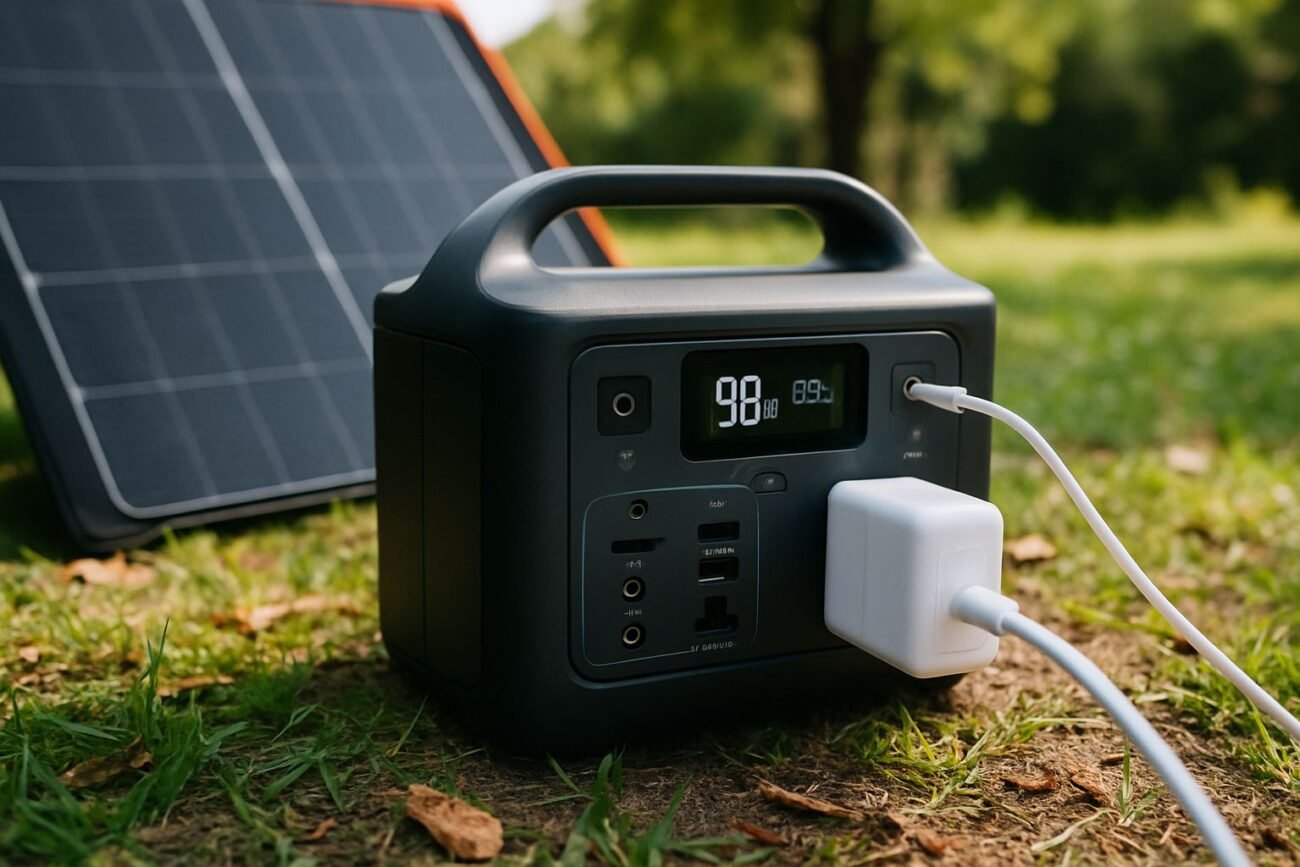
The River Pro weighs in at a reasonable 17 lbs, making it easy enough for one person to carry. While it’s not the lightest portable power station on the market, it’s not overly heavy either. EcoFlow has thoughtfully included a rear carry handle that is well-positioned and comfortable for short carries. This isn’t a unit you’d want to take backpacking, but for car camping, tailgating, or keeping it in a truck bed, the weight is a fair trade-off for the amount of power you’re getting.
Construction and Design
When you pick up the River Pro, you can tell that it’s well made. There’s no sound of plastic creaking, no inexpensive port covers, and a strong handle that makes you feel secure when you’re carrying it across a campsite. The matte finish doesn’t show fingerprints and the design is simple but not flashy.
Port Layout: Every Connection is Front-Facing
EcoFlow wisely decided to position all of the ports on the front of the unit. This means you don’t have to turn the station around or awkwardly reach behind it to plug anything in. The four AC outlets are grouped together and the USB ports and the 12V car socket are on either side of them — everything is clearly marked and logically laid out.
It’s worth noting the 100W USB-C port in particular. It charges a MacBook Pro at full speed, which is important if you’re working from a remote location like a campsite or a van. Not all portable power stations in this price range have a USB-C output at this level.
Screen Display and App Management
The LED display on the front of the unit provides at-a-glance information on battery percentage, input wattage, output wattage, and projected runtime. It’s sufficiently bright to be readable in daylight. When paired with the EcoFlow app, you can remotely monitor the unit, control the charging speed, and switch individual outlets on or off. The app is more than just a marketing afterthought; it’s genuinely useful.
Performance in Action
Numbers and features don’t mean much until you see them in action. Here’s how the River Pro performed in real-world testing.
What’s the Real-World Battery Life?
As is the case with any power source, the runtime will vary based on what you’re using it for. Here are some basic examples: if you’re using it to power a 50W laptop, you can expect about 12-13 hours of use. A 40W portable fridge will last approximately 15-16 hours. If you’re using it for a 60W CPAP machine, you’ll get about two to three nights of use before you need to recharge. This is great news for overlanders and van campers.
If you use the River Pro to power a high energy device such as a 750W blender or an electric grill, the battery will drain quickly. In fact, if you have a continuous draw of 800W, you’ll deplete the 768Wh battery in less than an hour. It’s simple math: if you plan your energy usage based on the battery’s capacity, you won’t run out of power unexpectedly while you’re on the go.
Real-World AC Charging Speed
The EcoFlow River Pro really shines when it comes to AC charging speed. When plugged into a regular 120V wall outlet with the AC charging cable that comes in the box, the River Pro can reach 80% charge in around one hour. It takes around 1.6 hours to fully charge the battery. This isn’t just a best-case scenario result from a lab test, this is the kind of performance you can expect in day-to-day use.
For comparison, most competitors in the same capacity range take three to five hours to fully charge using AC power. If you need to charge before a weekend trip or recharge at a campsite with shore power hookups, that speed difference is significant. Here’s what a typical AC charging session looks like:
- 0 to 80% charge: Approximately 1 hour at 940W input
- 80% to 100% charge: Approximately 30-40 additional minutes as the charger tapers down to protect battery health
- Total full charge time: Roughly 1.5 to 1.6 hours from empty
- Charging from a 12V car outlet: Significantly slower — expect 10+ hours for a full charge
- Dual charging (AC + solar simultaneously): Supported, and can push input higher when both sources are active
One thing worth noting — the River Pro does run its cooling fan during AC charging, and it’s audible. Not disruptive, but noticeable if you’re in a quiet tent or small van. More on that below.
Solar Charging: The Downside
The 220W solar input limit is functional, but not outstanding. With two EcoFlow 110W bifacial solar panels in perfect conditions, you can get close to that 220W limit — but solar conditions are never perfect. Factors such as partial cloud cover, less-than-ideal panel angle, and heat all reduce the actual input. In reality, you can expect 120W to 180W of actual solar input on a good day, which means a full charge in about 4-6 hours of strong sunlight. If you’re planning to use solar as your main power source, you might want to consider the Anker C800 Plus, which has a 300W solar input, instead.
Fan Noise: Varies and Can Be Distracting
The River Pro employs an internal cooling fan to regulate temperature while charging and during high-load discharge. The fan remains silent or doesn’t operate at all under low loads. When the AC output exceeds 400W, the fan noticeably spins up. It operates nonstop during full-speed AC charging — and while it’s not loud enough to interrupt sleep from across the room, it’s loud enough to be heard in a quiet setting.
The most annoying part is the inconsistency. The fan sometimes turns on unexpectedly at relatively low loads, which feels like the thermal management algorithm is tuned conservatively. It’s not a dealbreaker, but it’s a rougher experience than competitors who’ve dialed in smoother, quieter fan curves.
EcoFlow River Pro’s Strengths
Despite some minor hiccups, the River Pro is still an impressive product. Its fast AC charging, reliable battery chemistry, and well-thought-out port layout make it a cut above most of its competition in this price range. Whether you need it for weekend camping trips, overlanding, or as an emergency power supply for your home, it ticks more boxes than not.
Just the LiFePO4 battery chemistry is a huge reason to pick this device over less expensive alternatives that use traditional lithium-ion cells. Better thermal stability, longer cycle life, and safer operation in hot conditions — like inside a sun-baked truck cab — can make a significant difference over many years of use.
Power Four Devices at Once
It’s not often you find a portable power station that weighs less than 20 lbs and has four AC outlets. This feature is incredibly handy. You can run a fan, charge a laptop, power a portable fridge, and keep a lamp on — all at the same time. Most similar products only have two AC outlets, which means you have to pick and choose what to power or use a power strip. EcoFlow’s choice to include four outlets makes a difference every time you use the device.
Integration with the EcoFlow App
The EcoFlow app can be downloaded on iOS and Android devices and connects through Bluetooth and Wi-Fi, allowing you to monitor input and output wattage, battery percentage, estimated runtime, and individual outlet control in real time. You can also set a maximum charge level — capping at 80% to preserve long-term battery health — which is exactly the kind of thoughtful feature that eco-conscious users appreciate. The app is stable, responsive, and genuinely adds value rather than feeling like an afterthought.
Easy to Carry at 17 lbs With a Convenient Rear Handle
The EcoFlow River Pro hits the perfect weight balance at seventeen pounds for a 768Wh power station. It’s heavy enough to feel solid and sturdy, but light enough to easily carry with one hand using the built-in rear handle. The handle is well-made — there’s no bending, no sharp corners — and it’s located at the exact center of gravity so the power station doesn’t sway awkwardly when you’re transporting it.
Where the EcoFlow River Pro Falls Short
Like any product, the River Pro has its flaws. Depending on what you plan to use it for, these may be more than minor inconveniences — they could be real reasons not to buy. It’s important to be aware of these shortcomings before you decide to buy.
X-Boost Feature Does Not Always Work as Expected
EcoFlow’s X-Boost technology is promoted as a way to power devices that exceed the standard 800W AC output limit. In theory, it can allow appliances up to 1,600W to run by dynamically managing power delivery. In controlled tests with specific appliances, it does work. However, in real-world use with a variety of devices, X-Boost can be hit or miss. Some appliances that should theoretically run under X-Boost simply shut the unit down or trigger an overload warning. If you’re purchasing the River Pro specifically to run high-wattage devices, make sure to check your exact appliance compatibility before relying on X-Boost as your backup plan.
Doesn’t Include a Light
Not having a light might seem like a minor issue, until you’re trying to navigate a pitch-black campsite at 2 in the morning. The EcoFlow River Pro does not have a built-in light, not even a simple LED strip. Other brands, like the Anker C800 Plus, have included lights, which turns out to be a practical feature rather than just a selling point. If you’re planning to use this device outside after the sun goes down, be sure to bring a separate headlamp or lantern. This is a basic feature that EcoFlow should have included by now.
Solar Input Falls Short of AC Input Capability
There is a substantial difference between the River Pro’s 940W AC input and its 220W solar input maximum. EcoFlow has designed a device that charges incredibly quickly from the wall, but solar appears to be a secondary consideration. For those who want to go truly off-grid, relying on panels rather than shore power, that 220W maximum restricts how fast you can recharge after a deep discharge. On a cloudy day in the Pacific Northwest or during winter camping, you might only get 80W to 120W of actual solar input, making a full recharge a day-long or multi-day task.
Should you choose the EcoFlow River Pro or the Anker C800 Plus?
When it comes to the best portable power station under $500 with 768Wh capacity, it’s a toss-up between these two. The best one for you depends on what you’re looking for.
|
Feature |
EcoFlow River Pro |
Anker C800 Plus |
|---|---|---|
|
Battery Capacity |
768Wh LiFePO4 |
768Wh LiFePO4 |
|
AC Output |
800W (1,600W surge) |
800W (1,600W surge) |
|
AC Input |
940W |
1,440W |
|
Solar Input |
220W |
300W |
|
AC Outlets |
4 |
4 |
|
Built-In Light |
No |
Yes |
|
App Control |
Yes |
Yes |
|
Weight |
17 lbs |
19.4 lbs |
The Anker C800 Plus charges faster from both AC (1,440W input vs 940W) and solar (300W vs 220W). It also includes a built-in light. The EcoFlow River Pro is lighter by about 2.4 lbs and has a more refined app experience. If fast solar charging and a built-in light matter to you, the Anker wins. If you prioritize weight savings and a slightly more polished software ecosystem, the EcoFlow is the better pick. Both use LiFePO4 chemistry and offer identical AC output — so the core performance is a wash.
Who Would Benefit Most from the EcoFlow River Pro?
The EcoFlow River Pro is perfect for campers and overlanders who spend their weekends off the grid and need to quickly recharge their power station between trips. It’s also great for van lifers who occasionally have access to shore power and want to recharge their power station as quickly as possible. For those who need an emergency backup power source for their home, the EcoFlow River Pro can keep lights, phones, a CPAP machine, and a small fridge running during a power outage. The four AC outlets and fast recharge time make this power station a valuable tool.
This unit is not the right fit for anyone planning to live solely off solar power — the 220W input limit is too restrictive for that purpose. It is also not ideal for powering high-wattage appliances above 800W on a regular basis, given X-Boost’s inconsistent performance in real-world situations. As long as you know what you’re purchasing it for, the River Pro delivers. If you use it outside its strengths, you’ll run into problems.
Commonly Asked Questions
Here are the most frequently asked questions potential buyers have about the EcoFlow River Pro, answered honestly and without the sales pitch.
How much time does the EcoFlow River Pro need to be fully charged?
When charging from a typical 120V wall outlet, the EcoFlow River Pro can reach 80% in about an hour and fully charge in around 1.5 to 1.6 hours. This is made possible by its 940W AC input, which is one of the quickest charging rates for portable power stations of this size. Charging from a 12V car outlet, on the other hand, is much slower and can take over 10 hours to fully charge.
Is the EcoFlow River Pro capable of powering a mini fridge?
Indeed. The majority of 12V and 120V portable camping fridges — such as the BougeRV CR55 or Dometic CFX3 35 — consume between 30W and 60W on average, which is well within the River Pro’s 800W continuous output range. A fully charged 768Wh battery can power a portable fridge for approximately 15 to 16 hours at a 45W average draw before it needs to be recharged. The River Pro can easily handle the peak startup surge of 150W to 200W that compressor-based fridges can momentarily reach.
How long does the EcoFlow River Pro battery last?
The River Pro’s LiFePO4 battery is rated by EcoFlow to support over 3,000 full charge cycles before its capacity drops to 80% of its original 768Wh. This means that if you were to use it daily and fully charge it once a day, it would last for over eight years. This is a significant improvement over portable power stations that use standard lithium-ion cells, which typically degrade to 80% capacity in 500 to 800 cycles.
Most users will replace the River Pro due to damage or obsolescence before the battery itself wears out. For eco-conscious buyers, this longer lifespan means less electronic waste and a better return on the environmental and financial investment of the purchase.
Is the EcoFlow River Pro compatible with all solar panels?
The EcoFlow River Pro can receive solar input through an XT60 connector and is compatible with panels that output between 11V and 30V DC. It is designed to work with EcoFlow’s own solar panels — including the 110W and 160W bifacial models — as well as many third-party panels that use the same connector or an appropriate adapter. The important specification to match is voltage: panels must output within the 11V to 30V range to work with the River Pro. The total solar input is limited to 220W, no matter how many panels you connect.
Is the EcoFlow River Pro a good buy compared to other portable power stations?
The EcoFlow River Pro is priced competitively for a 768Wh LiFePO4 power station with four AC outlets and 940W AC charging. The quick charge speed alone makes it worth more than its slower-charging competitors. However, the value proposition becomes more complex when you compare it to the Anker C800 Plus — at a similar price, Anker provides quicker AC and solar charging, as well as a built-in light.
If you’re looking for a quick wall charge and a light, sleek design with a sophisticated app, the River Pro is worth the cost. However, if you’re after the best solar performance or the fastest charging speed for your money, the Anker C800 Plus has a slight advantage. There’s no wrong choice here – each option addresses a slightly different need.
When it comes to utilizing clean, portable power for camping, van life, or emergency preparedness, The Solar Lab is your go-to resource. We provide comprehensive comparisons, solar pairing guides, and real-world testing breakdowns to help you find the perfect setup for your energy needs.
Sure, could you please provide the AI content you’d like me to rewrite?
