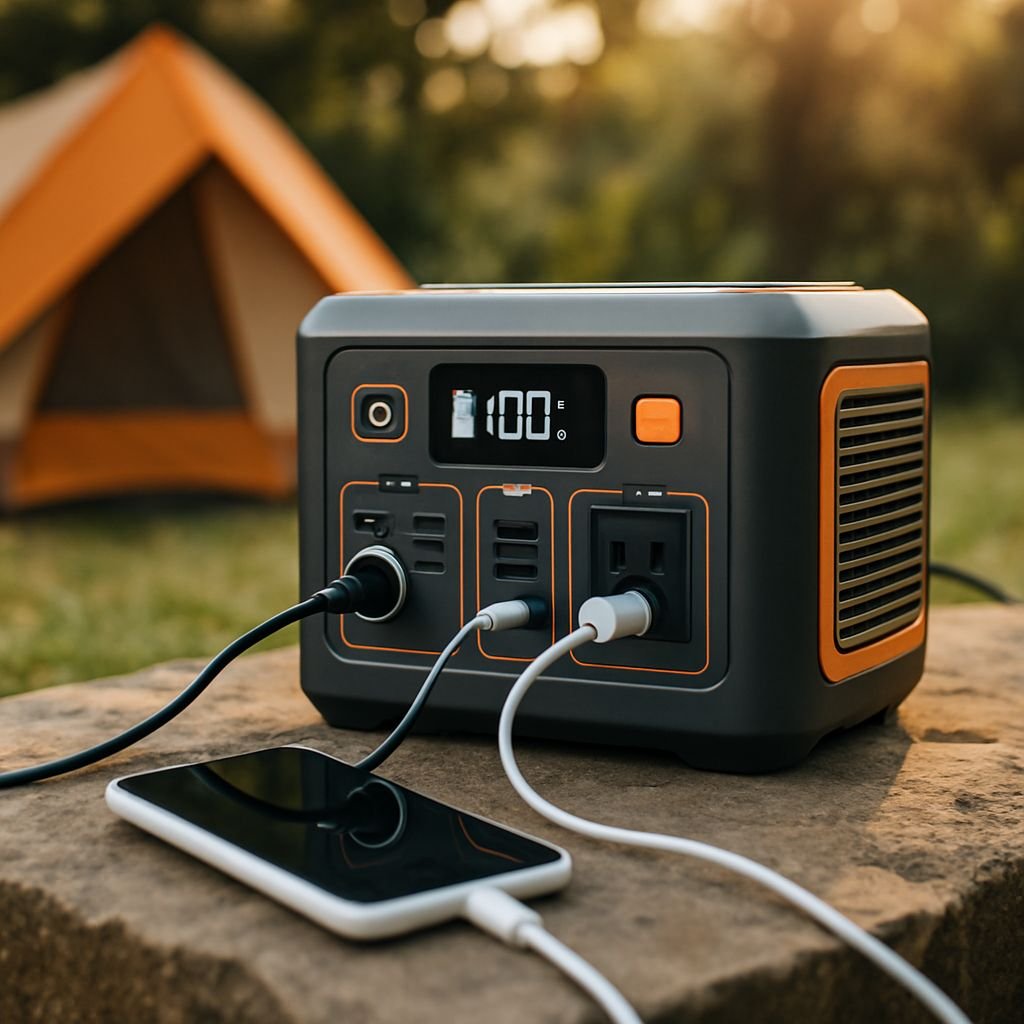
Quick Comparison: Jackery Explorer 1000 vs. EcoFlow River 2 Pro
- The Jackery Explorer 1000 has been discontinued — if you’re comparing it to the EcoFlow River 2 Pro, the EcoFlow wins on charging speed, smart features, and overall value per dollar.
- The EcoFlow River 2 Pro charges from 0–100% in just 70 minutes via wall outlet using X-Stream technology — the Jackery Explorer 1000 takes several hours by comparison.
- Despite having a larger 1000Wh capacity, the Jackery Explorer 1000 delivers less continuous AC output (1000W) than you might expect versus the River 2 Pro’s more compact 768Wh paired with solid 800W output.
- Both units support Bluetooth app control and solar charging, but EcoFlow’s ecosystem and software integration goes significantly deeper.
- There’s a budget alternative worth considering — keep reading to find out which newer models have replaced both of these in 2025.
Choosing the wrong portable power station can leave you literally in the dark — so let’s break down exactly how these two units stack up before you spend a dollar.
The Jackery Explorer 1000 and the EcoFlow River 2 Pro are both similarly priced and are often compared by campers, van lifers, and emergency preppers. Both brands have made a name for themselves in the solar generator market. Jackery is known for its reliability and user-friendly design, while EcoFlow is known for its boundary-pushing fast-charging technology. If you want a more in-depth comparison of how each brand approaches off-grid power, resources like Solar Way Point offer detailed side-by-side comparisons and updated buying guides for the off-grid community.
Before we start, it’s important to note that the Jackery Explorer 1000 is no longer in production. This is a significant point, particularly if you’re thinking about purchasing a second-hand unit or comparing it to more recent models in the same series.
Jackery Explorer 1000 is No Longer Available — What This Means for You
If you were considering the Jackery Explorer 1000, you’ll need to change your plans. Jackery has moved on to newer models like the Explorer 1000 Plus, which offers more capacity and better output. The original Explorer 1000 may still be available on third-party marketplaces, but buying discontinued hardware means no warranty support, no firmware updates, and potential difficulty finding replacements. For the purpose of this comparison, we’ll reference its original specs — but note that the EcoFlow River 2 Pro is the currently supported, in-production model.
Capacity of Battery: 1000Wh vs. 768Wh
Just looking at the specs, the Jackery Explorer 1000 takes the cake with a 1002Wh capacity, while the EcoFlow River 2 Pro falls behind with 768Wh. That’s about 30% more energy storage. This difference is significant for longer off-grid trips where recharging isn’t always possible.
What Does the Capacity Difference Mean for Practical Use?
Raw watt-hours are just one piece of the puzzle. A 1000Wh station can theoretically power a 60W laptop for about 14–16 hours, taking into account inverter efficiency losses (usually 85–90%). The River 2 Pro’s 768Wh provides approximately 11–13 hours of the same usage. For a weekend camping trip, both are more than enough. However, for a 5-day backcountry expedition without access to solar power, the Jackery’s additional capacity becomes a significant benefit.
Which Battery Type Lasts Longer
The EcoFlow River 2 Pro is powered by a LFP (Lithium Iron Phosphate) battery, which is known to last for 800+ charge cycles before its capacity drops to 80%. LFP batteries are more thermally stable and have a longer lifespan than the NMC (Nickel Manganese Cobalt) lithium cells that power the original Jackery Explorer 1000. This difference in battery type can result in hundreds of additional usable charge cycles over a 5-year ownership period, which can significantly affect the long-term value of the device.
In other words, the Jackery has a larger energy capacity right now, but the EcoFlow is expected to have a larger energy capacity in five years.
Understanding AC Output Power: What Can Each Station Power?
While capacity indicates how long a station can power a device, AC output determines which devices it can power. These are two distinct specifications, and misunderstanding them is a frequent error made by purchasers.
Jackery Explorer 1000: 1000W Continuous, 2000W Peak
The Jackery Explorer 1000 offers 1000W of continuous AC output and a 2000W surge/peak. This surge capacity is handy for appliances with high initial power demands — such as a small refrigerator compressor or a power tool. With 1000W of continuous power, it can easily manage most camping necessities: a portable fridge, CPAP machine, LED lights, and phone charging at the same time.
EcoFlow River 2 Pro: 800W Continuous, 1600W Peak
The River 2 Pro operates at a continuous 800W and a peak of 1600W, which is less than the Jackery in both aspects. However, EcoFlow has included an X-Boost feature that allows it to power certain appliances rated up to 1800W by smartly managing output. This narrows the gap for appliances like small hair dryers or electric kettles when used in X-Boost mode.
Without X-Boost, the River 2 Pro’s 800W ceiling means it can’t power a standard 1000W microwave or a 1200W coffee maker without overloading. The Jackery can power those without any issues.
What Each Unit Can Power
| Device | Wattage | Jackery Explorer 1000 | EcoFlow River 2 Pro |
|---|---|---|---|
| Laptop (60W) | 60W | ✓ Yes | ✓ Yes |
| Mini Fridge | ~150W | ✓ Yes | ✓ Yes |
| CPAP Machine | ~30–60W | ✓ Yes | ✓ Yes |
| Standard Microwave | ~1000W | ✓ Yes | ✗ No (without X-Boost) |
| Electric Kettle | ~1200W | ✓ Yes | ✗ No (without X-Boost) |
| Hair Dryer (low) | ~800W | ✓ Yes | ✓ Yes (at limit) |
Charging Speed: EcoFlow River 2 Pro Takes the Lead
When it comes to charging speed, the EcoFlow River 2 Pro doesn’t just win — it crushes the competition. This is a key factor that is often overlooked in spec sheets, but it’s why many people prefer the EcoFlow over the Jackery.
Understanding EcoFlow X-Stream Technology
The River 2 Pro, thanks to EcoFlow’s unique X-Stream charging technology, can handle up to 600W of AC input. This means you can charge it from zero to full in just about 70 minutes. Most portable power stations charge at 200–300W from a wall outlet, which typically takes 4–6 hours. X-Stream turns a partial charge into something you can actually use — even if you only have 20 minutes to charge before you leave, you’ll still have a decent amount of power.
Wall Charging Time: Jackery Explorer 1000 vs. EcoFlow River 2 Pro
The Jackery Explorer 1000 charges from an AC wall outlet at around 200W input, so you’re looking at a total charge time of about 7–8 hours from zero. That’s at least an overnight charge — not a problem if you’re able to plan ahead, but it could be a constraint if you need to quickly recharge between uses. When you compare that to the River 2 Pro’s full charge in just 70 minutes, the difference is hard to ignore if you’re on the move a lot or if your access to power is unpredictable.
When you think about van-life or camping, this difference is huge. Picture pulling up to your campsite with a nearly dead unit — the Jackery needs to sit plugged in overnight before it’s ready, while the EcoFlow River 2 Pro is back to 100% before you’ve even finished dinner. For emergency home backup situations, being able to recharge quickly is just as important when grid power temporarily comes back on during a power outage.
Comparison of Solar Charging Input
The EcoFlow River 2 Pro is capable of accepting up to 220W of solar input, while the Jackery Explorer 1000 can handle up to 200W. Although these numbers appear similar on paper, EcoFlow’s MPPT charge controller is often more efficient at extracting power from fluctuating sunlight conditions. This means that the EcoFlow River 2 Pro tends to perform better in overcast skies, partial shading, and low-angle morning sun. Both devices support combined AC and solar simultaneous charging, which can significantly reduce total recharge time when you have access to a panel.
Ports and Outlets: Which Station is More Versatile?
The number and type of output ports determine how many devices you can run simultaneously and whether you need an additional hub or splitter along with your power station. Both units are well-equipped, but there are significant differences in their layout and priorities.
When it comes to port selection, the EcoFlow River 2 Pro takes the lead with its more contemporary offerings. It features a USB-C port with 100W Power Delivery, allowing you to rapidly charge a MacBook, iPad Pro, or a newer Android device without the need for an adapter. In contrast, the Jackery Explorer 1000’s USB-C output is limited to 18W. While this is adequate, it is noticeably slower when charging devices that consume a lot of power.
A Breakdown of USB-A, USB-C, and AC Outlet
| Type of Port | Jackery Explorer 1000 | EcoFlow River 2 Pro |
|---|---|---|
| AC Outlets | 3 x 110V (pure sine wave) | 3 x 120V (pure sine wave) |
| USB-A | 2 x USB-A (12W each) | 2 x USB-A (12W each) |
| USB-C | 1 x USB-C (18W) | 2 x USB-C (100W PD each) |
| DC Car Port | 1 x 12V/10A | 1 x 12V/10A |
| DC5521 Ports | 2 x DC ports | 2 x DC5521 ports |
Camping vs. Home Backup: Which Setup is Better?
When it comes to camping and van-life use, the EcoFlow River 2 Pro’s dual 100W USB-C ports are a clear winner — you can fast-charge two laptops or a laptop and a drone battery at the same time without touching the AC outlets. For home backup scenarios where you’re running a lamp, a fan, a phone, and a small appliance simultaneously, the Jackery Explorer 1000’s three AC outlets and higher continuous wattage give it a practical advantage for traditional plug-in appliances.
Weight, Size, and Portability
Portability isn’t just about weight — it’s about how the unit feels in your hand during a 10-minute walk from the car to the campsite. Both of these stations are designed with a carry handle, but their physical profiles are quite different.
Size and Weight Comparison: Jackery Explorer 1000 vs. EcoFlow River 2 Pro
With a weight of 22 lbs (10kg) and dimensions of 13.1 x 9.2 x 11.1 inches, the Jackery Explorer 1000 is a bit on the heavier side. On the other hand, the EcoFlow River 2 Pro is considerably lighter at 17.2 lbs (7.8kg) even with its comparable features — that’s almost a 5-pound difference! As for its size, the River 2 Pro is 10.2 x 7.2 x 10.2 inches, making it more compact and easier to fit into a car trunk or under a van bench seat.
Which One Is More Convenient to Take on a Trip
When it comes to portability, the EcoFlow River 2 Pro is the clear winner. It’s almost 5 pounds lighter and physically smaller, making it the better option for fitting in a backpack — although neither of these units is meant for serious backpacking. If you’re frequently loading gear into the bed of a truck, the hatch of a kayak, or an RV storage compartment, the difference in weight and size will become noticeable over the course of a full trip.
Smart Features and App Control
Both devices offer Wi-Fi and Bluetooth app connectivity, but the app experience from EcoFlow is more robust and polished. The EcoFlow app allows you to monitor the wattage of input/output in real-time, set limits on charging to protect the longevity of the battery, and control the device remotely, including the ability to schedule charging windows. The app from Jackery offers the basics – battery status, wattage monitoring, and some adjustments to settings – but it doesn’t have the depth of the platform from EcoFlow. Neither device offers a touchscreen, but both have clear LED display panels that show wattage data and battery level at a glance.
Cost vs. Benefit: Which One Offers More Bang for Your Buck?
Back when the Jackery Explorer 1000 was still being manufactured, it was sold for around $999. The EcoFlow River 2 Pro is priced at approximately $499–$549, depending on the seller and any ongoing deals — nearly half the cost. With the lower price tag, you get quicker charging, better battery technology, a lighter device, and superior USB-C output. The Jackery’s selling point was always its larger 1000Wh capacity, but with double the cost, the benefit-to-cost ratio heavily favors EcoFlow.
Should you find yourself in need of the additional 232Wh capacity provided by the Jackery, a more apt comparison would be between the Jackery Explorer 1000 Plus (starting around $799) and the EcoFlow Delta 2 (also ranging from $799–$999). Both the River 2 Pro’s successor and the 1000 Plus are representative of the current generation of each brand’s mid-range lineup — and comprehending their position within the larger product ecosystem is just as important as the specifications themselves.
Jackery Explorer 1000 Scored 36/100, EcoFlow River 2 Pro Scored 47/100
Independent review platforms rate the EcoFlow River 2 Pro at 47/100 and the Jackery Explorer 1000 at 36/100 in head-to-head evaluations — a significant 11-point difference primarily driven by charging speed, battery technology, port versatility, and app functionality. The Jackery’s score reflects its aging design and discontinued status more than any fundamental flaw in its original build quality. When it was released, the Explorer 1000 was considered a premium unit. Today, the EcoFlow River 2 Pro simply outperforms it in nearly every measurable category.
Other Options to Consider
If the EcoFlow River 2 Pro doesn’t seem like a significant upgrade from the discontinued Jackery Explorer 1000, it might be worth considering the EcoFlow Delta 2 and Jackery Explorer 1000 Plus. The Delta 2 has a 1024Wh capacity and a 1800W AC output, and it retains EcoFlow’s fast-charging capabilities — it can fully charge in roughly 80 minutes from a wall outlet. The Jackery Explorer 1000 Plus increases capacity to 1264Wh and improves solar input, making it a much more powerful upgrade from the original Explorer 1000.
EcoFlow Outperforms Jackery, But There’s Still a Case for Jackery
When it comes to charging speed, battery longevity, weight, port quality, and overall value per dollar, the EcoFlow River 2 Pro clearly outdoes the Jackery Explorer 1000. For most buyers in 2025, it’s the better choice — especially if fast recharging and a lightweight build are important. However, Jackery has earned its reputation as one of the most trusted names in portable power for a reason. Their newer lineup, particularly the Explorer 1000 Plus, improves on many of the original unit’s weaknesses and remains a viable option for buyers who want a reliable, straightforward power station without the steeper EcoFlow learning curve. If you specifically need higher continuous AC output for running demanding appliances, Jackery’s newer models still offer that advantage in a user-friendly package.
Common Questions and Answers
Below are some of the most frequently asked questions from buyers when comparing these two power stations, with straightforward answers to help you make the best decision for your setup.
Should You Still Consider Purchasing the Jackery Explorer 1000 in 2025?
Given that the Jackery Explorer 1000 is no longer in production, potential buyers should be aware of a few significant issues. The lack of an ongoing warranty, no updates for the firmware, and limited availability outside of the resale market mean that there is a considerable risk associated with purchasing a used model.
Should you stumble upon one at a significantly reduced price — let’s say, less than $400 — and you’re alright with taking on those risks, the underlying hardware is still in working order. Its 1002Wh capacity and 1000W continuous AC output are truly useful specifications that can power a campsite efficiently. The issue is that the NMC battery chemistry causes each cycle to slightly degrade the capacity, and a used unit with an unknown cycle history could already be operating well below its rated capacity.
Most consumers will find that it’s more beneficial to invest in a current-generation model. The EcoFlow River 2 Pro, which costs around $499, and the Jackery Explorer 1000 Plus, priced at about $799, both provide better long-term value, active support, and updated features that the original Explorer 1000 simply can’t compete with.
Is it possible for the EcoFlow River 2 Pro to power a refrigerator?
Indeed — the EcoFlow River 2 Pro is capable of powering a 12V portable camping fridge (such as the BougeRV or Alpicool models that draw 40–60W) for a prolonged duration, possibly 12+ hours, depending on the fridge’s compressor cycle. A typical household refrigerator that draws 150–200W falls within the River 2 Pro’s 800W output capacity, but the 768Wh battery would be drained after approximately 3–4 hours of operation. To ensure continuous backup for a home refrigerator, pair the River 2 Pro with solar panels to indefinitely extend the operating time during daylight hours.
Which Portable Power Station Can Be Charged Quicker Using Solar Power?
The EcoFlow River 2 Pro can take in up to 220W of solar input, while the Jackery Explorer 1000 can only take in a maximum of 200W. If you are using a high-efficiency panel like the EcoFlow 220W Bifacial Solar Panel, the River 2 Pro can be fully charged in about 3–5 hours of direct sunlight. The Jackery Explorer 1000, when paired with a Jackery SolarSaga 200W panel, will have almost the same but slightly slower results. The EcoFlow’s MPPT charge controller is also better at recovering more usable energy in partially shaded or overcast conditions, giving it an advantage in real-world solar charging scenarios.
How Long Does the EcoFlow River 2 Pro Battery Last?
The EcoFlow River 2 Pro has a lifespan of over 800 charge cycles to 80% capacity, thanks to its LFP (Lithium Iron Phosphate) battery. This means you can use it daily for more than 2 years before you’ll see any significant degradation. And many LFP batteries continue to perform well beyond their rated cycle count, albeit at reduced capacity. In contrast, the Jackery Explorer 1000, which uses NMC chemistry, is typically rated for about 500 cycles under the same conditions. So the River 2 Pro is a much better long-term investment.
Can I Use Either Power Station While Charging?
Yes — you can use both the EcoFlow River 2 Pro and Jackery Explorer 1000 while they are charging. This is called pass-through charging, which means you can power devices from the unit while it’s also being charged from a wall outlet or solar panels. EcoFlow calls this simultaneous charge and discharge. One thing to keep in mind: if you’re running high-wattage devices while also charging at full AC input, it can produce extra heat. So, you should keep the units in a well-ventilated area and avoid using pass-through charging for a long time in hot conditions.
Which Power Station Is Better for Emergency Home Backup?
For emergency home backup, the Jackery Explorer 1000 holds an edge in raw capacity (1002Wh vs. 768Wh) and higher continuous AC output (1000W vs. 800W), meaning it can run more household devices simultaneously for longer periods during a power outage. However, the EcoFlow River 2 Pro’s 70-minute recharge time is a major advantage when grid power briefly returns — you can top it up completely in the time it takes to eat a meal, versus the Jackery’s 7–8 hour overnight recharge requirement. For extended multi-day outages paired with a generator or solar, EcoFlow’s faster charge recovery wins. For a simpler “plug in and wait” backup approach, the Jackery’s larger capacity makes it the more forgiving option.
Can the EcoFlow River 2 Pro work with EcoFlow Solar Panels?
Can EcoFlow Solar Panels work with the River 2 Pro?:
The EcoFlow River 2 Pro can take in solar input through an XT60 connector with a voltage range of 11–30V and a maximum solar input of 220W. It is fully compatible with EcoFlow’s own panel lineup, including the following:
- EcoFlow 160W Portable Solar Panel — foldable, perfect for car camping and single-panel setups
- EcoFlow 220W Bifacial Solar Panel — most efficient in the EcoFlow lineup, captures light from both sides
- EcoFlow 400W Rigid Solar Panel — goes over the River 2 Pro’s 220W input cap when used alone, requires pairing with a higher-capacity station like the Delta Pro
For the fastest solar charging speed on the River 2 Pro, the EcoFlow 220W Bifacial Solar Panel is the best match — it hits the unit’s input ceiling without going over it, delivering the quickest possible solar recharge under ideal conditions.
Third-party solar panels can also work with the River 2 Pro as long as they are within the 11–30V input voltage range and use or adapt to an XT60 connector. Popular third-party options like the Renogy 200W Eclipse Solar Panel work well in practice, provided the panel’s open-circuit voltage doesn’t go over the River 2 Pro’s input specifications — going over voltage limits can damage the MPPT charge controller and void the warranty.
Here’s a helpful hint that’s often forgotten: if you connect two smaller panels in parallel (instead of series), you can keep the voltage within safe limits while increasing the current. This is a useful setup if you have two 100W panels but need to stay under 30V. Always double-check your panel configuration before connecting to keep both the panels and the power station safe.
Whether you need power for your campsite, are getting ready for storm season, or are building a van-life electrical system, understanding the real-world differences between the EcoFlow River 2 Pro and Jackery Explorer 1000 can help you choose the right power station for your needs. The specs alone don’t tell the whole story — factors like charging speed, battery chemistry, port layout, and long-term support are just as important as raw watt-hours when you’re relying on a power station in the field.
For most buyers in 2025, the EcoFlow River 2 Pro is the stronger all-around unit, while the updated Jackery Explorer 1000 Plus is the preferred choice for those who want a higher-capacity, higher-output option from a brand they trust. Either way, the original Jackery Explorer 1000 is no longer the best option — the current generation of portable power stations from both brands is significantly better in almost every important category.
